
Jungian Analysis
Psychotherapy & Supervision
The invitation
to a deeper transformation
journey
.
Psychotherapy & Jungian Analysis
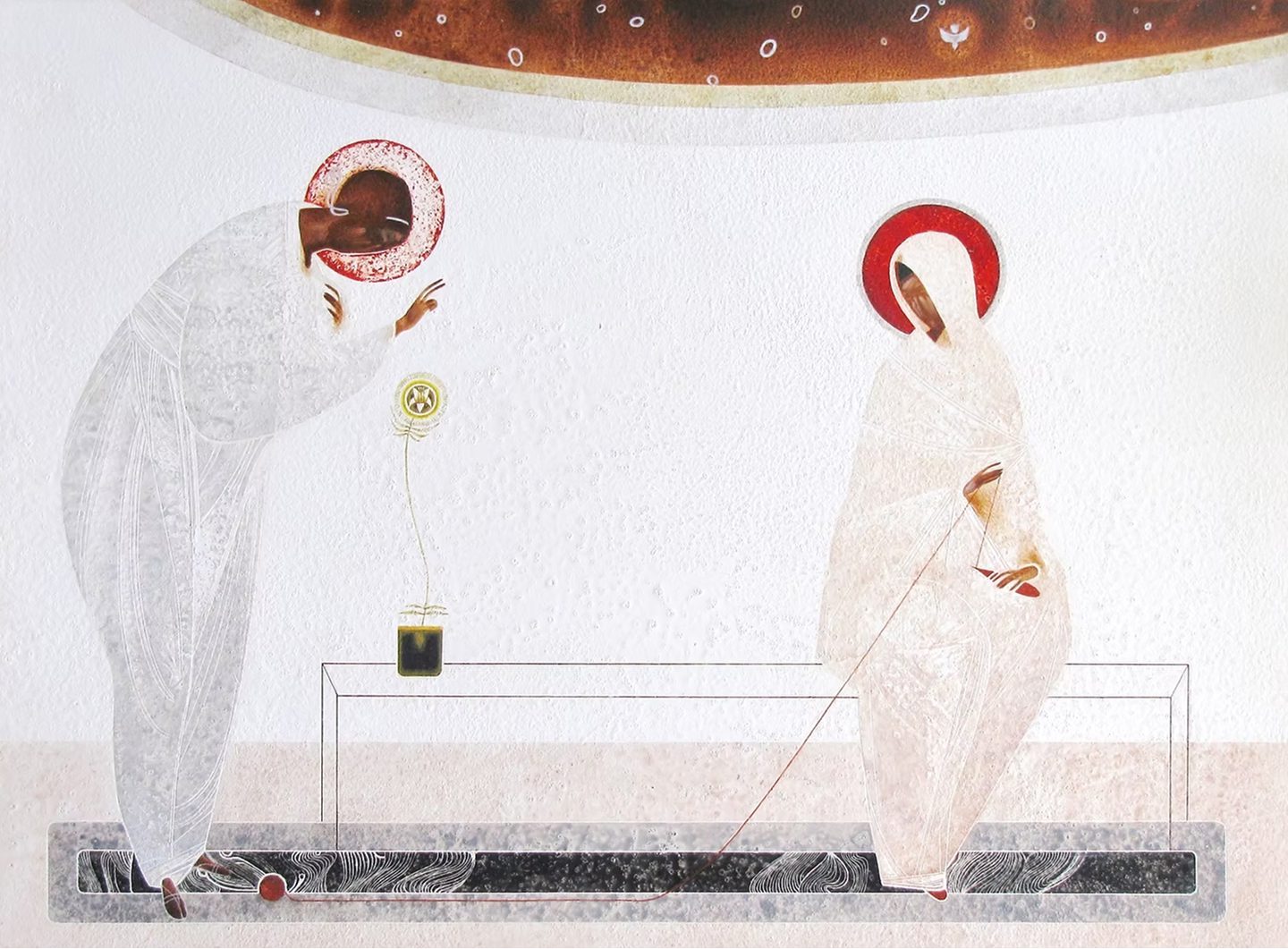
I am drawn to this image by the Ukrainian artist Ivanka Demchuk. It exquisitely depicts the moment in the Christian tradition when the angel Gabriel, sent by God, asks Mary whether she consents to bear and give birth to the Son of God, to the Divine. What strikes me most is the respect with which the angel makes the request—and the fact that Mary could always have said no! Fortunately she said yes, and so, within the Christian tradition, a new era of “salvation history” begins.
I have chosen this image for this page because it seems to me that when we first feel the promptings to begin psychotherapy or analysis—or to return to do further work—we are being invited into a process of transformation. If it goes well, we are reborn in a way that carries a particular quality: we may feel more free, our lives may change significantly, relationships and health can improve, and we discover a more solid inner foundation and sense of security. At times the process can feel almost miraculous, leaving us wondering how such change has come about.
There are many ways of understanding this journey: as the hero’s journey, as an alchemical process, or through other symbolic or cultural frameworks. Each of us may find our own language, tradition, or imagery. Whatever speaks to us, we feel called to set out. We do not know the destination, and we know it will be demanding and require work, yet most of us have a sense that we are searching for healing and transformation. In analysis, the analyst pays close attention to the analysand’s unconscious in order to support them in finding their own unique path.
One reason I trained as a Jungian analyst is that its teleological approach suits me. Rather than asking only what has gone wrong, we ask: What is this psyche trying to do? Where does it want to go? Analytical psychologists speak of the individuation process—a movement towards self-realisation, authenticity, and wholeness; the integration of all parts of oneself; the fulfilment of one’s potential as fully as possible. In Analytical Psychology we seek to encounter something greater than the ego within—often called the Self.
This may involve paying attention to dreams and synchronistic events; active imaginations and creative expression may also deepen the process. The work invariably involves working through what hinders us: early life experiences, trauma, cultural and relational patterns, and more. It also means encountering our “shadow”—those parts of ourselves we would rather not acknowledge. Yet Jung once suggested that the shadow is “80% gold”: our unlived life, our hidden potential.
While it will be evident from my website that I am interested in the spiritual dimension, the body is equally important. It is through the body that we first experience the world, and it is present in every experience we have. As Bessel van der Kolk’s The Body Keeps the Score so powerfully demonstrates, the body carries our history and can reveal much about who we are, how we feel and what it is that we need.
The body may also be holding trauma, which is why I spent several years training in Sensorimotor Psychotherapy, an approach that offers a safe and effective way of working with traumatic material. I find its integration of neuroscience-informed techniques particularly valuable. At times, a purely “talking cure” cannot reach where the work needs to go.
In practical terms, some clients work on the couch, others face to face; some attend once or twice a week, while others choose a more intensive process of three or four times weekly. Sessions may take place online or in person.
If you hear a call to a deeper journey, I encourage you to have the courage to say yes—even knowing that there will be difficult moments—because you may bring something very precious to fruition within yourself. It is a different journey when you do not walk it alone.
Supervision
When I was a student I came across M.Scott Peck’s book “The Road Less Travelled”. It starts “Life is difficult. This is a great truth, one of the greatest truths. … once we truly see this truth, we transcend it.”
Supervision, too, is difficult – whether being supervised or offering supervision. There is no denying that it is complicated and that it operates in a highly sensitive arena.
It can also be immensely rewarding and a rich relationship. Together the supervisee and supervisor can open themselves to the depth of the work. It requires a humility of approach on both sides, an acceptance of not knowing and having all the answers, of patience as we learn our craft – and, of course, it requires work.
C G Jung is often quoted:
“The meeting of two personalities is like the contact of two chemical substances: if there is any reaction, both are transformed.”
— C. G. Jung, The Practice of Psychotherapy, CW 16, §163
I offer supervision to psychotherapists and Jungian analysts at all stages of their professional development, including to Routers on the IAAP Router Training.
My approach is rooted in Jungian theory and clinical practice, with careful attention to the symbolic field, transference and countertransference, ethical complexity, and the lived experience of the work. Where appropriate, I may also utilise neuro-scientifically-informed approaches from other modalities such as Sensorimotor Psychotherapy.
Supervision is about both the analysand and the supervisee and the process in which they are engaged. Sometimes it is about the supervision process itself, institutional issues or practical matters.
I aim to foster a supervisory relationship that is supportive, containing, honest, respectful, explorative, collaborative, sometimes challenging and just a little playful – a space that enables supervisees to develop confidence, depth, and their own authentic analytic voice.
Jungian analyst August Cwik wrote:
“The goal of analytical supervision is to promote the fullest expression of the professional-self of the supervisee” (2006 J.Anal. Psychol., (510(2):209-225) I think that puts it very well.